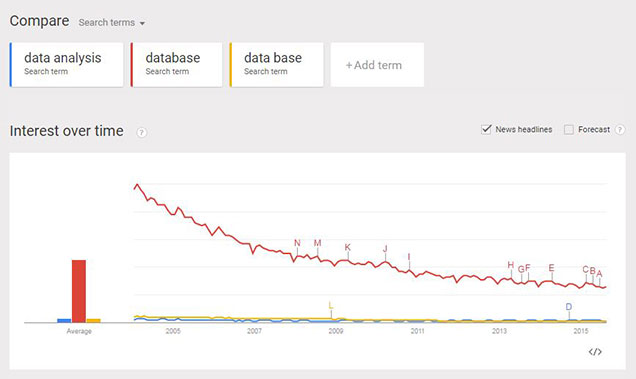
google.com/trends graph
I’m hooked on data analysis. My journey started with my love of databases – those wonderful repositories of information on our primary audiences. Then along came Google Analytics. Or should I say, I finally caught up with it.
For those of you who are uninitiated, Google Analytics is an awesome tool that allows you to track visitor behaviour on your website. You simply place some Google code on your website and Google will collect information on what pages people visit, how long they stayed and a whole range of other useful data.
One of the things I discovered is that more than half the traffic going to websites does so through search. And what makes your site most likely to get clicked? It will if it appears on the first page of organic search results. If you’ve been playing around with websites, you’d know that something called “search engine optimisation” is the most important factor in ensuring your site has a high ranking. What this boils down to is having search terms (called “key words”) that are not only relevant to the content on your website, but popular with people doing searches.
Take the key words “database” and “data base”. The former is way more popular as google/trends will show you. You can see a screen shot of the graph in the picture above (click it to see a larger version). This means that research on optimal key words using tools like Google Trends is important in planning your site content.
And if that wasn’t enough, I discovered Google AdWords, which allows you to buy your way onto the first page of search results. But to get there it’s not just a big budget that helps. What comes into play is something called the Quality Score (QS) of your ads. A big part of this is the key words you use in the ad text as well as the article on the destination page on your website. You also need to try and use these key words the article title, copy and metadata. If you have a high QS, you get the best spots in searches and pay less per click on ads. On top of that, your website will be more likely to appear high up in the organic search results.
So here I am every morning examining our Google Analytics account checking out the success of our campaigns by see if we get more visits, deeper engagement and so on. The other part of the exercise is nuancing the ads in Google AdWords to attract traffic and analysing the metrics in Google Analytics.
But what it all seems to come down to is getting the most popular key words, using them wisely and increasing the Quality Score of your ads. I’m in database heaven not just with all the data that Google collects, but the tool they provide to analyse it.
So looking forward to attending the Google Analytics Users Conference next week. Stay tuned for the gems I get from there.