 Content marketing is something all website owners should work to perfect.
This post will give you some pointers. It contains a few gems I picked up recently on the how-to of creating great web content.
It’s all about how to say more with less.
Content Marketing
Last week, I heard a great talk on content marketing called “How to Write Website Content That Attracts Your Ideal Supporter” by writer and communications consultant, Rachel Kurzyp, of RK Consulting.
Part of the Connecting Up 2016 Conference, it was one of the stand-out presentations.
Rachel was not only an engaging speaker but clearly knew her subject well. In essence, she said that great web content is about “saying more with less”.
The Content Marketing Institute describes it as:
a strategic marketing approach focused on creating and distributing valuable, relevant, and consistent content to attract and retain a clearly-defined audience — and, ultimately, to drive profitable customer action.
I took note of Rachel’s hot tips for content marketing. I expand on them here with a few other suggestions on Search Engine Optimisation (commonly referred to in web development as SEO). This is all the things we need to do to get our websites found via search engines such as Google. Effective content marketing relies on good SEO.
Know your audience
Probably the most important thing Rachel talked about was to know your audience. She gave some guidance on how to find out more about your ideal readers:
- Get to know the needs and wants of your current customers
- Conduct surveys
- Keep an eye on social media to see what comments your prospective customers are making
She suggested to answer these questions in detail:
- What does my audience day look like right now?
- What would be their perfect day?
- How does my business make that happen?
Rachel said that what you’re trying to do is identify the problems your reader is facing and then aim to provide solutions. She said that if you’re selling a service, not a product don’t think that these questions don’t apply.
You need to help your audience. All you need to do to find out is ask them how!
Clearly defining and getting to know your audience is ‘Marketing 101’. If you get this right, then you’ll get your product or service right. When you have a clear idea of what you’re selling, who you’re selling it to and what their needs and wants are, you’re ready to write your articles.
Writing your article
Tip of the day with writing was:
Always free-write before editing
Rachel said to just do a brain dump of your ideas. She said nobody gets it right first time. Get your ideas down and then come back and fine tune your writing with a good edit.
Fine-tune your writing
Check for correct grammar and that you have all the correct punctuation. Rachel’s tips are:
- Keep sentence short and simple (write to grade 7 level)
- Remove extra words
- Avoid repetition, jargon and acronyms (I know, I use SEO in this post!)
- Use active not passive voice (eg short, sharp content)
Rachel told us about a couple of free online tools to help with this (I even used them to write this post!):
- Grammarly (if you use the wrong word and MS Word doesn’t pick it up)
- Hemingway app (checks complexity of sentences)
Share great content
It goes without saying that we should share great content. After all, the old adage “content is king” still holds true. Rachel suggested using infographics as one way of explaining different activities in your business.
In fact, in another talk during the conference, we heard that for good SEO we should be minimising the number of photos we use and try using scalable vector graphics such as Font Awesome because these load much faster and fast-loading websites are what Google loves!
Font Awsome graphics (can easily be changed in size to suit)
If you use photos, get them to tell the story of your business. And remember to reduce their size. This is VERY important because, again, good SEO is about your web pages loading quickly. If they don’t, you will lose your visitors. Also, Google will punish you by not optimising your site to appear high in search results.
Rachel also talked about publishing videos. These days, it’s very easy to self-publish. All you need is a reasonable quality smartphone and tripod. The good thing about video content is that it will not only enhance your website but can be easily shared through social media (in fact video content is the most shared content).
Be genuine – try not to be clever
SEO
This is a huge and important topic. Rachel only touched on it briefly in her talk as she was mostly focussed on creating great content. This is because ‘content is king’. Good quality original content is vital for SEO.
SEO involves any means of creating and publishing your website content that will provide an optimal user experience.
The things to consider with SEO include how quickly your web pages load and metadata. Besides keeping image sizes small, you need to use ‘alt’ tags to describe what they are (this is for people that rely on screen readers). If you use WordPress, a helpful plugin is Yoast. It will prompt you to fine tune your headings, writing, keywords, and metadata.
Another great tip from Rachel is to get the meta description right so people want to share your content. The meta description is a short description of the article that the search engines see and then produce in search results. If it’s meaningful and relevant to the person searching for your site, they are more likely to visit your site and share it.
Headlines
Great headlines will get people to click on your stories, bad ones send them to other websites.
Rachel said that your headline should at least do one of these things:
- be unique
- ultra-specific
- convey a sense of urgency
- useful
Every time you write a headline, ask yourself if your readers would be interested and intrigued. If not, re-write your headline so it is clear, concise and specific.
She said that where news-style writing is ideal for press releases, for web articles you’re best to use one of the following well-known headline formulas:
7 Headline formulas
- How To …
- Here’s How …
- Learn How …
- Ask a question …
- The Lists
- Numbers
- Attention … [target market]
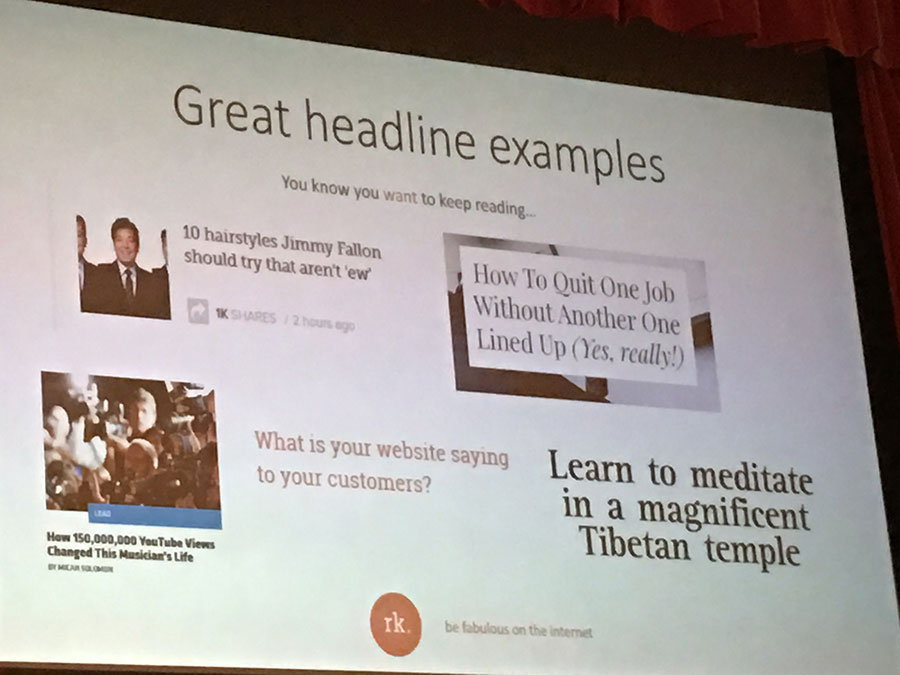
A slide in Rachel’s presentation of ‘Great headline examples’
Further content marketing tips from Rachel are to:
- Include a call to action
- Spell things out multiple times (saying them in different ways)
She suggested the following words and phrases to prompt action:
- To find out more
- For a demonstration
- For more information
- To book
- Call now
- Learn more at
- Donate now
Layout
What we need to aim for here is a layout that makes it easy for people to scan your copy.
Rachel reminded us that most people only read the first paragraph. So it’s vital for effective content marketing to have the most important information first. She said to break up the content with headings, sub-headings, and images. And I loved that she said “embrace white space” – not enough people do. To make the call to action very clear, think about the Google home page!
No one wants to wade through a copy dump to get to the juicy bits.

A slide in Rachel’s presentation of the ‘inverted pyramid’ model for writing
She suggested we think about using different types of content to ensure people absorb it. To improve the effectiveness of your content marketing include visual elements like infographics, videos, photos, diagrams and slide shows.
In fact, having both text and visuals increases your web pages accessibility and credibility
I found Rachel’s checklist for how to finesse content marketing very helpful. I even used it to write this post. Tools like Yoast (installed on this WordPress site) and the inline editing by Grammarly ensured that I had all the right metadata in place and that my writing was at least more grammatically correct. And when I gave this post to my friend to proofread, he very helpfully quoted elements of the checklist back at me like “you’re using SEO – it’s an acronym!”.